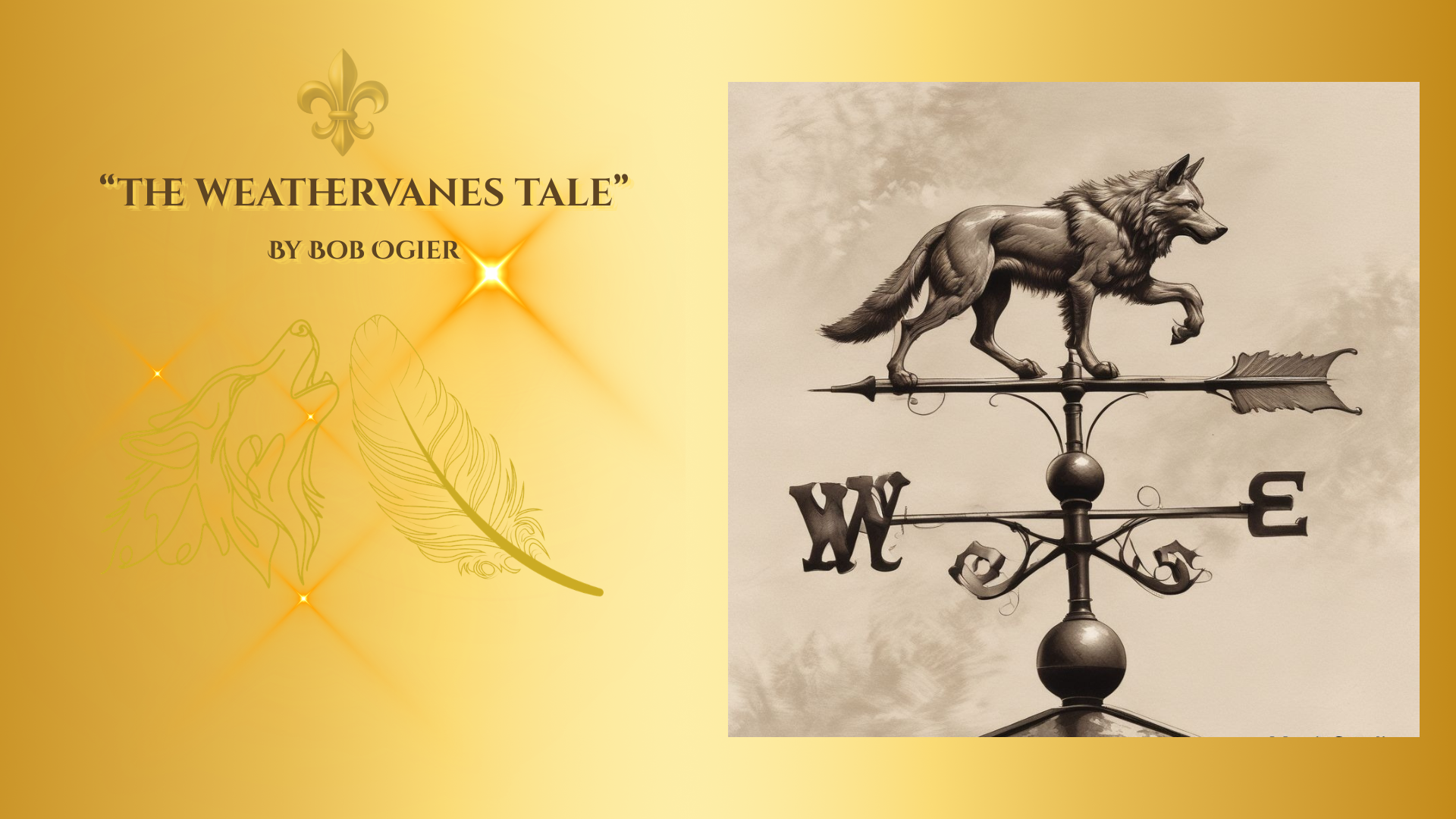
Chapter XXXIII
The Weathervane's Tale
by Bob Ogier
The wind spent years telling him where to point. Wisdom arrived when he stopped listening.

You do not discover who you are by following every wind. You discover who you are when you stop turning long enough to listen to yourself.
Countless individuals spend decades of their lives existing strictly as psychological weathervanes. We turn instantly toward social approval, we turn toward fleeting cultural trends, we turn out of deep-seated fear, we turn away from harsh criticism, and we turn to satisfy the impossible expectations of others. The fundamental problem with this dynamic is not that the winds of life exist; the problem is actively believing that these external forces should possess the authority to determine who we ultimately become. The weathervane at the center of this musical narrative spends the majority of the track utterly exhausted by continuous reaction—every outside opinion becomes a binding command, every shift in circumstance dictates a new direction, and every passing storm escalates into a full-blown internal crisis.
Then, a truly remarkable shift occurs: nothing. The wind continues to blow across the sky, the structural storms continue to roll through the valley, and life continues to swirl around him—but the weathered instrument simply stops chasing every passing change. And in that quiet space of complete stillness, he finally discovers something he could never find while caught in endless motion: himself. The underlying lesson is wonderfully quiet but deeply profound: peace does not magically arrive when our life circumstances finally become completely stable; peace arrives when we do.
The modern world is entirely full of competing winds—opinions, heavy expectations, institutional pressures, moving trends, raw fear, empty praise, and unmerited criticism. Many individuals spend their finite lifetimes turning reactively toward whichever force happens to blow the strongest in that exact hour. But an internal identity built upon continuously changing winds will always remain fundamentally unstable. The weathervane eventually discovers that true human wisdom is not learning how to masterfully predict or avoid every incoming storm; wisdom is learning precisely where your own True North lives inside the chest. Once that core compass is located, the wind completely loses its power to define us. The storms will still come, and the clouds will still gather, but they no longer possess the strength to determine our ultimate direction.
The Weathervane's Tale brings the massive journey of The Allegory Song Bible to a beautiful, triumphant conclusion with a lesson that quietly and brilliantly echoes through every single chapter that came before it. The Merchant painstakingly learned that precious time cannot be purchased in the marketplace; the Climber learned that ultimate victory is located exclusively within; the Prisoner learned that deep truth lies far beyond our immediate reflection; the River taught the necessity of quiet remembrance; the Gladiator taught the power of absolute endurance; and the Weathervane finally teaches the world peace. This peace is achieved not because the outside winds have miraculously stopped blowing, but because he finally understands that they were never truly in charge of the dial. The storms remain, the earthly seasons change, and the world continues its frantic spinning—yet the old weathervane stands perfectly calm beneath the vast sky. Weathered, rust-stained, and deeply wise, he finally faces the one direction that feels completely true.
Track 33 — The Weathervane's Tale